The First Coffee Designed bya Neural Network
Not a gimmick. Not "AI-assisted." We built a complete data pipeline: thousands of products taxonomized, hundreds of sub-types classified, flavor and quality determinants modeled with near-perfect accuracy. The output? Products that fill real gaps in the global beverage taxonomy.
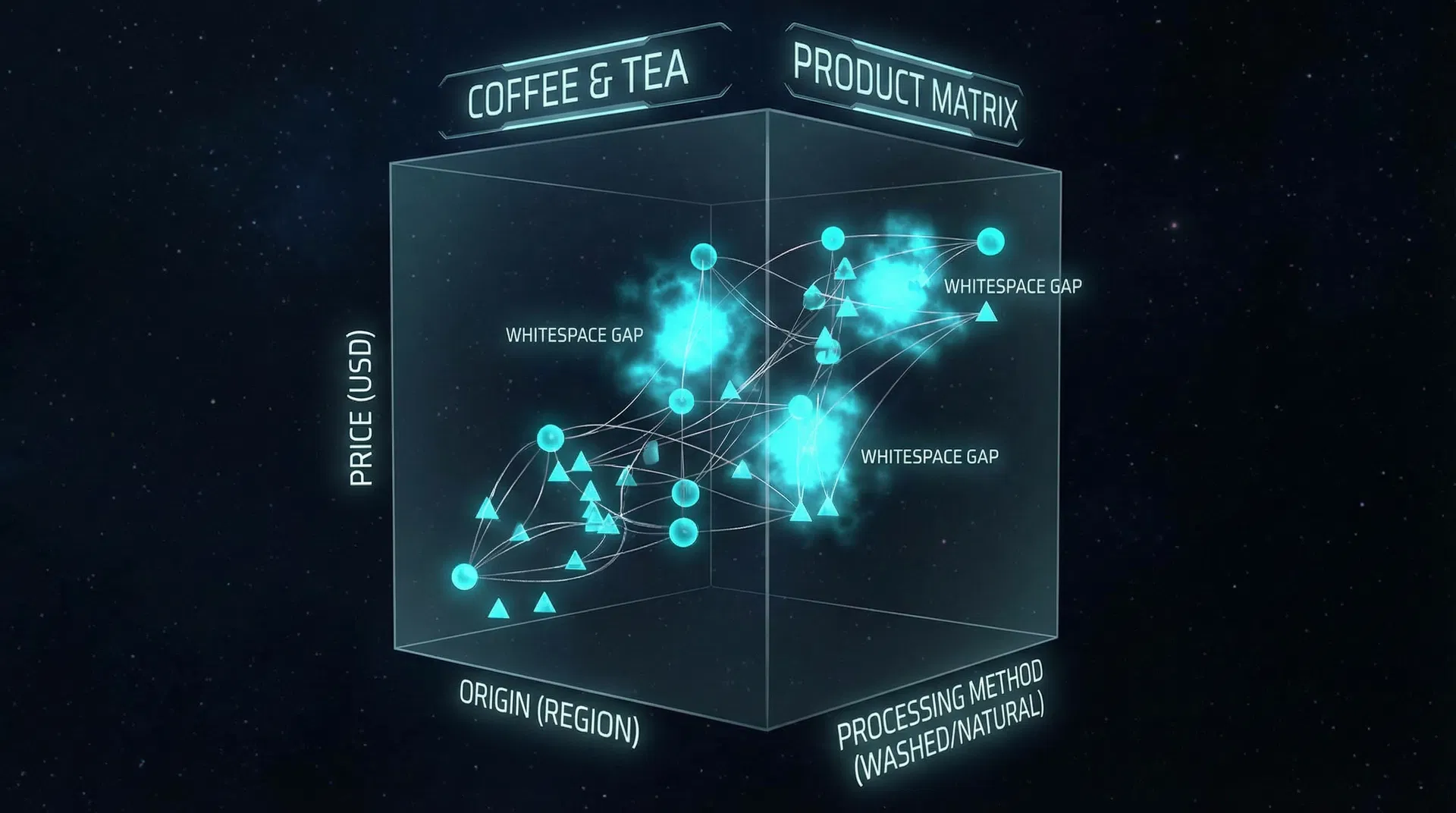
The Technical Stack
This isn't marketing fluff. Here's the actual data science pipeline behind every Synapse product.
Global Beverage Taxonomy
Every commercially available tea and coffee mapped with 18+ attributes per product across 88 countries.
Predictive Flavor Model
Machine learning models predicting flavor profiles and optimal processing parameters with near-perfect accuracy.
Gap Detection Algorithm
Cross-referencing type × origin × process matrices to find products that should exist but don't.
Flavor Compound Prediction
AI models trained on molecular interactions to predict taste profiles before production begins.
Processing Optimization
Ultrasonic, hyperbaric, and SIAF parameters tuned by gradient descent on sensory outcomes.
Continuous Learning
Every batch feeds back into the model. The more we produce, the better the predictions get.
How We Found the Whitespace
# Synapse Gap Detection Pipeline
taxonomy = load_global_taxonomy(countries=88, attributes=18)
flavor_model = train_predictor(taxonomy, target="flavor_profile")

# Cross-reference: Type × Origin × Process
gap_matrix = cross_tabulate(
  taxonomy,
  dimensions=["type", "origin_country", "processing"],
)

# Result: India has hundreds of Black, many Green, 0 Yellow
# Result: Taiwan has hundreds of Oolongs, 0 Yellow
# Result: Japan has hundreds of Green, 0 Yellow
whitespace = gap_matrix.where(count == 0)

# Yellow tea is the rarest and most prized category
# → New Yellow tea products identified across 3 origins
optimal_set = optimize_portfolio(whitespace)
print(f"New products designed: {len(optimal_set)}")
# → Teas, Coffees, and Functional Tisanes
Ship Your Taste Buds to Production
Be among the first engineers, PMs, and founders to taste what happens when you apply real data science to a $500B industry.